What degree of investment goes into building relations between the cultures of two countries that are situated thousands of kilometres apart? media update speaks to Takamitsu Hida — Second Secretary in the Political and Public Relations Sections at the Embassy of Japan in South Africa — for whom it all lies at the heart of building opportunities to learn from one another.
The practice of public diplomacy involves balancing a vast understanding of what distinguishes cultures, communities and audiences from one another — with applying that understanding to achieve a mutually beneficial exchange.
Hida shares his insights into the precision that relates to the planning of cultural events, the importance of inter-cultural understanding, as well as how communication can successfully be utilised to strengthen the people-to-people amalgamation of two respective cultures.
Bridging the geographical gap between South Africa and Japan, Hida explains the Embassy's approach through its communication efforts to employ the connection between the two cultures — to make the distance between them symbolically, yet significantly, smaller.
As Second Secretary at the Embassy of Japan in South Africa, what does your typical day look like, and how much of your role involves communication and public engagement?
The balance between my work in the Political Section and Public Relations Section varies depending on the time of year and the Embassy's priorities. For example, when we held the Japanese Festival 2026 in June this year, I focused largely on preparations for the festival, including social media posts and other forms of public outreach and communication.
About a month before the festival, in contrast, Japanese Foreign Minister MOTEGI Toshimitsu visited South Africa. During that period, my responsibilities were quite different. As an officer in the Political Section, I concentrated mainly on preparation for the Japan-South Africa Foreign Ministers' Meeting and logistical coordination related to Minister's visit.
Because my responsibilities cover both political affairs and public relations, no two days are exactly the same, which makes it difficult to describe a single "typical" day. In general, however, I begin my morning by reviewing the latest news and political developments.
From lunchtime through the afternoon, I often attend meetings and events with various stakeholders, both to deepen our understanding of developments in South Africa and to advance projects and initiatives involving the Embassy. Communication and public engagement are an important part of my work, whether through direct meetings, coordination with counterparts, or public outreach activities.
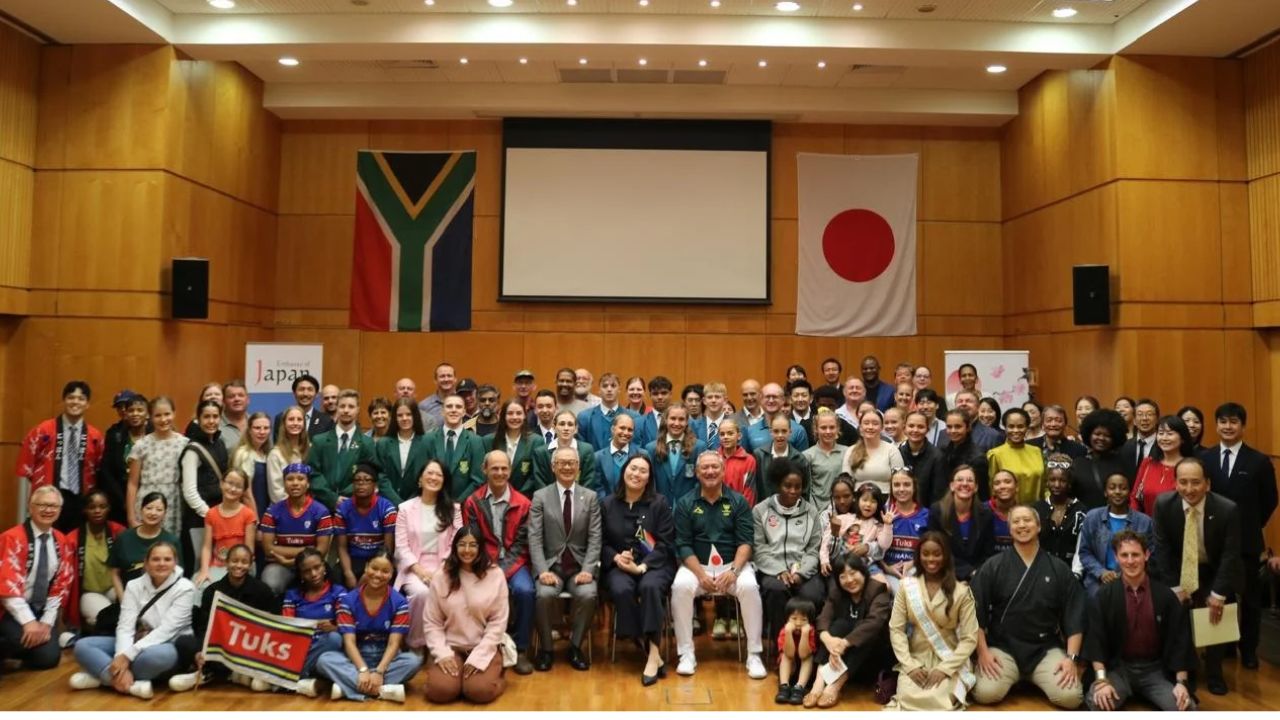
The Embassy hosts a variety of cultural and sporting events throughout the year. What goes into planning and communicating these events to ensure they resonate with South African audiences?
When preparing for our cultural or sporting events, we place particular importance on creating them together with the people of South Africa. Japan and South Africa are geographically very far apart, so there are naturally some challenges when it comes to inviting performers or participants directly from Japan.
However, we see this distance not simply as a difficulty, but as an opportunity to create events that are unique to South Africa.
For example, there are many South African individuals, groups and associations that practice Japanese martial arts such as karate, judo, kendo and kyudo, as well as Japanese cultural traditions including ikebana and bonsai. Their passion and long-standing engagement with Japanese culture allow us to present these traditions in a way that is both authentic and locally rooted.
For the Japanese Festival in June, we collaborated with a number of local South African groups, and they represented Japanese culture beautifully in their own ways. One display that particularly struck me was a bonsai made from a baobab tree. It was something we would rarely see in Japan, and to me it symbolised the unique fusion of Japanese and South African cultures.
I believe this kind of combination can create something with a character and value that cannot be found anywhere else in the world. When communicating our events, particularly through social media, we therefore try not only to introduce Japanese culture itself, but also to show how it is being embraced, interpreted and developed here in South Africa.
Inter-cultural communications is at the heart of diplomacy. What are some key considerations when communicating Japanese culture and values to a diverse South African audience?
I believe that, ultimately, relationships between countries are built on relationships between people. In this regard, I see tremendous potential for Japan and South Africa to further deepen our people-to-people ties and cultural exchanges.
One reason is that, despite the geographical distance between our two countries, there are important similarities in the values and spirit of our societies.
Since I arrived in South Africa a little over one year ago, I have heard about the spirit of Ubuntu countless times. As a Japanese citizen, the idea often expressed as "I am because we are" has resonated deeply with me, particularly because Japan has also traditionally placed great importance on harmony and respect for others.
A well-known example comes from the early seventh century. In 604, Prince Shotoku, an important political figure in ancient Japan, introduced what is known as the Seventeen-Article Constitution. Its very first article begins with the principle that "harmony should be valued".
This illustrates how deeply rooted the idea of harmony has been in Japanese society for many centuries. In that sense, I think there is meaningful common ground between Japanese and South African society in the importance of community, respect, and social harmony. The popularity of Japanese martial arts such as karate, judo, kendo and kyudo in South Africa may also reflect, at least in part, this shared appreciation for discipline, respect, community and harmony.
When communicating Japanese culture and values to a diverse South African audience, I therefore think it is important not simply to present Japan as something unfamiliar, but to identify these connections. I would like to continue creating opportunities through which more South Africans can discover such connections and feel that Japanese culture is not something remote, but something with which they can find meaningful common ground.
Did you find this Q&A insightful? Let us know in the comments section below.
Want to stay up-to-date with the latest news? Subscribe to our newsletter.
*Images courtesy of Takamitsu Hida